Microlaunch Alternatives for Indie Founders (2026)
The best Microlaunch alternatives for indie SaaS and AI founders in 2026 are Easy Save AI, Product Hunt, Uneed, BetaList, Hacker News Show HN, Launching Next, and Indie Hackers. Which one deserves your attention depends on what you're actually trying to get - permanent directory listings, do-follow backlinks, pre-launch beta signups, raw reach, or founder-community feedback.
Transparency note: Easy Save AI, the publisher of this page, is itself a Microlaunch alternative. It appears in this list. We have been upfront about that and evaluated every platform on the same five criteria.
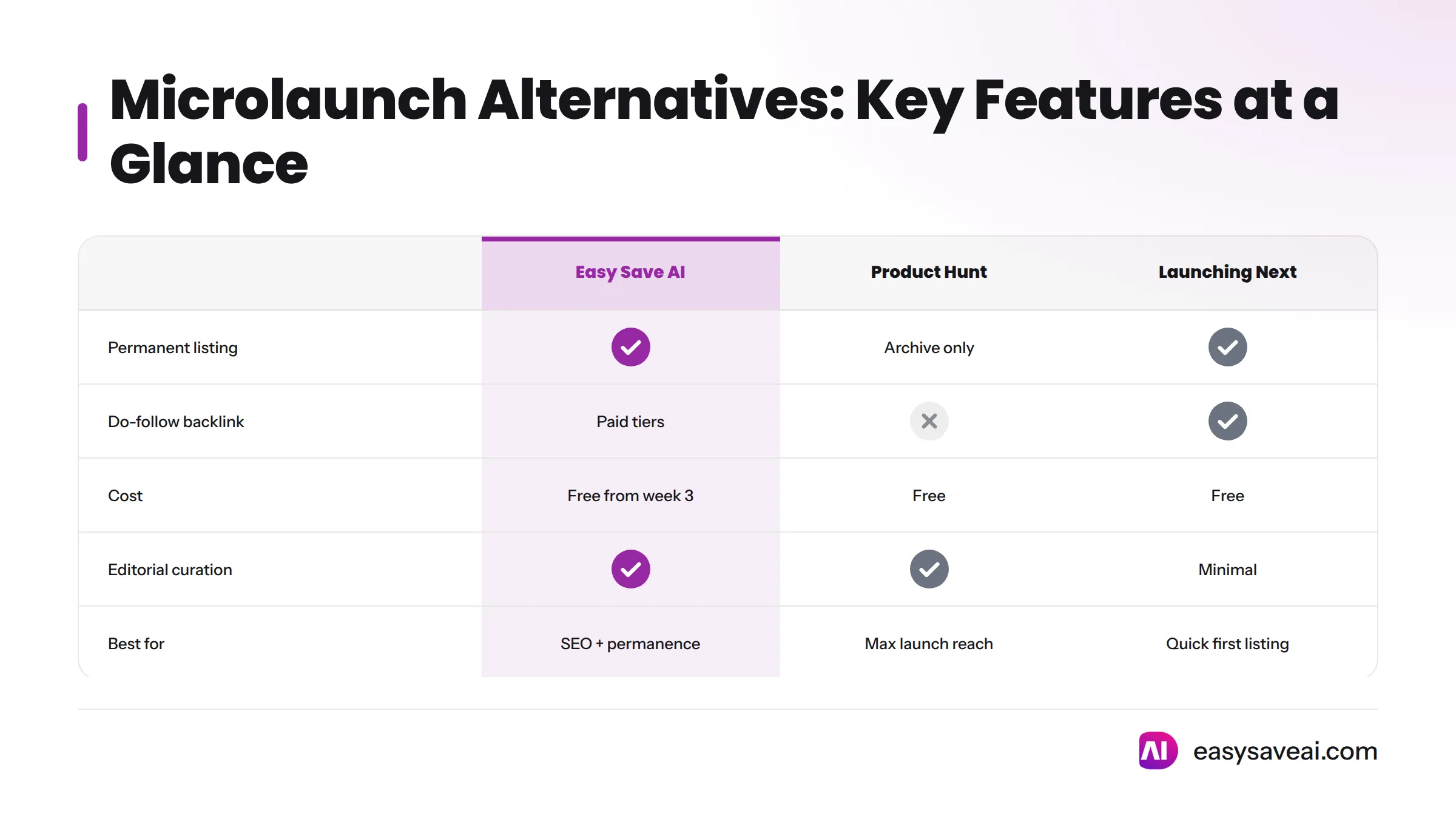
Here's the quick-reference breakdown before we go deeper:
| Platform | Permanent Listing | Do-Follow Link | Free Tier | Best For |
|---|---|---|---|---|
| Easy Save AI | Yes - permanent | Yes (paid tier) | Yes (from week 3) | Indie SaaS & AI tools, SEO value |
| Product Hunt | Archived but not promoted after launch day | No-follow | Yes | Maximum launch-day reach |
| Uneed | Permanent archive page | No-follow (verified via site audit) | Yes | Weekly curated drops |
| BetaList | Permanent listing page | No-follow | Freemium | Pre-launch beta signups |
| Hacker News Show HN | No dedicated listing | No | Free | Developer-focused feedback |
| Launching Next | Permanent directory page | Do-follow (as of 2026) | Yes | Low-friction early-stage listing |
| Indie Hackers | Product profile page | No-follow | Free | Founder community validation |
Scope note: This page covers indie product launch and directory platforms only. For a broader breakdown of similar platforms, see alternatives to Product Hunt on Easy Save AI.
What Microlaunch Is - and Why Founders Look Elsewhere
Microlaunch is an indie product launch and listing platform built for solo makers, early-stage SaaS founders, and AI tool builders. It offers a curated directory where new products get a slot during a launch window, with the goal of earning early user attention and an SEO-friendly backlink from the listing.
Founders typically look for Microlaunch alternatives and sites like Microlaunch for a few specific reasons. Some find the submission pipeline opaque or the launch slot scheduling too restrictive. Others discover that listing permanence is inconsistent - meaning the SEO value of the backlink depends heavily on whether the product page stays indexed and promoted long-term. And some simply want to spread their launch across multiple platforms at once to widen early-adopter reach.
Choosing the right platform, or the right combination of platforms, can be the difference between a launch week that generates 50 signups and one that generates 500.
How We Evaluated These Microlaunch Competitors
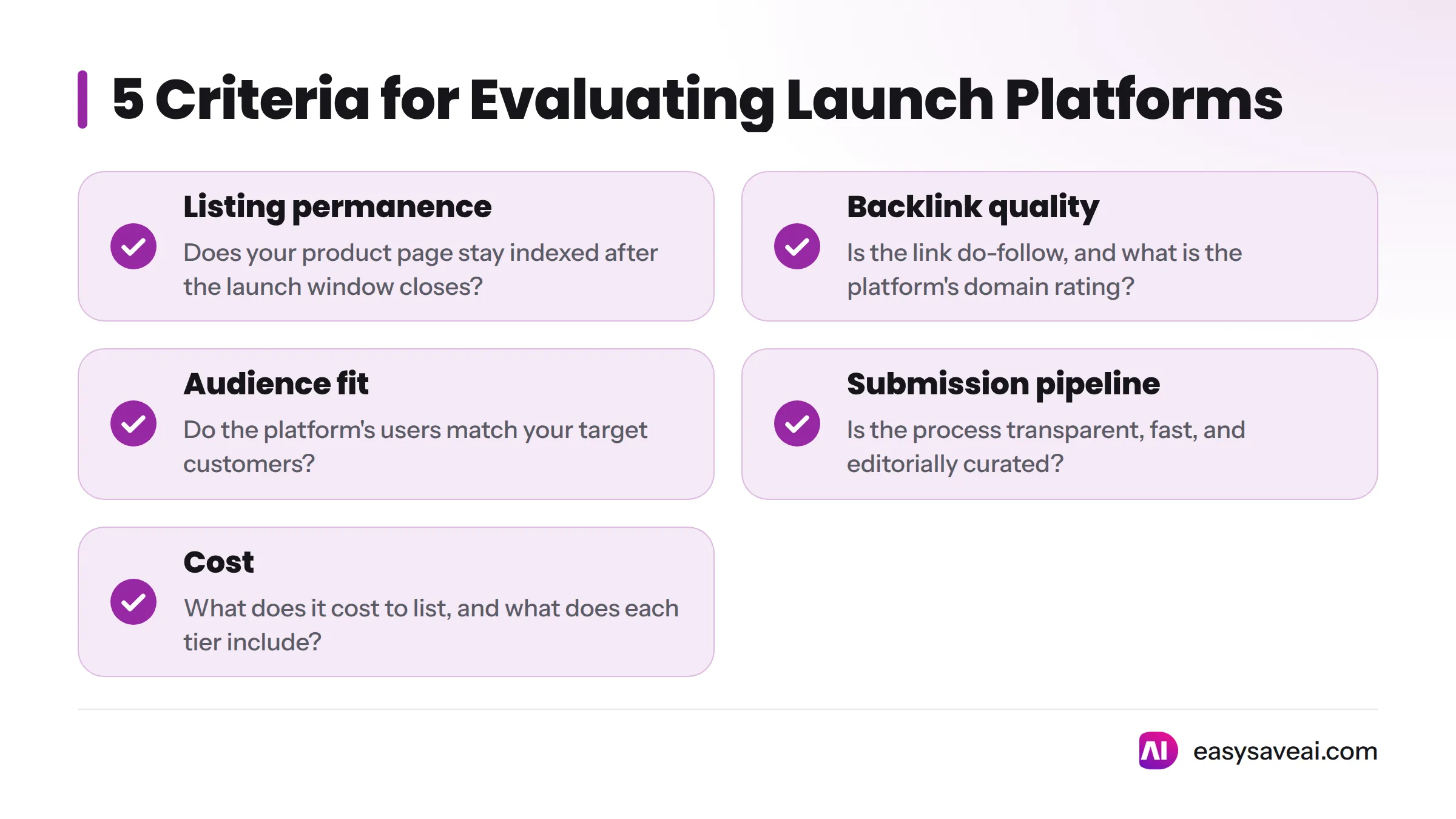
Easy Save AI's founder built and operates one of the platforms on this list. That means we know the submission pipeline, the listing mechanics, and the SEO decisions that go into a launch platform from the inside. These are the five criteria applied to every platform below.
Listing Permanence
A permanent listing means your product page stays indexed on the platform indefinitely after your launch window closes. That matters because a live, indexed page continues to pass link equity and can appear in search results for queries related to your product category - long after launch day. A rotating or time-boxed listing stops delivering that value the moment the window closes. I've watched founders obsess over launch-day traffic while completely ignoring whether the backlink they just earned would still be live three months later. That's the wrong order of priorities.
Backlink Quality
Do-follow links pass PageRank - the signal Google uses to assess a page's authority - from the linking domain to your site. No-follow links do not pass that equity directly. When a listing platform carries a strong domain rating (DR), a do-follow link from it can meaningfully lift your own site's authority. A no-follow link still delivers referral traffic and brand visibility, but it contributes nothing to your DR. Use our free domain rating checker to assess any platform before you submit.
Audience Fit
Early adopters, developers, fellow founders, and mainstream consumers are four very different audiences. Submitting a no-code AI productivity tool to a platform that skews toward open-source developer tools will get you feedback but not customers. Know who is on the other side of the submit button.
Submission Process
Human review means a curator reads your submission and decides whether it meets the directory's standards. Automated or community-vote systems move faster but offer less curation signal - which affects how much trust the platform's audience extends to listed products.
Cost
Free tiers let you list at no cost, usually with some scheduling or feature limitations. Paid tiers typically unlock earlier launch slots, premium placement, or do-follow link status. Each platform's cost structure is covered below, with links to live pricing pages where available.
1. Product Hunt - Best for Maximum Reach and Community Upvotes
Product Hunt is the largest and most established product launch community on the web. Products are submitted and compete for upvotes on a daily leaderboard. The top products on any given day earn significant visibility across a newsletter, social channels, and a large early-adopter community.
The main difference from Microlaunch is scale. Product Hunt's community is orders of magnitude larger, which means launch-day exposure can be substantial - but competition is fierce. Launching on a Tuesday in December against 50 other products is a very different experience from launching quietly on a niche platform.
Listing permanence: Products remain in Product Hunt's archive indefinitely, but the upvote algorithm is entirely time-boxed to launch day. After 24 hours, your product stops competing for visibility and effectively disappears from the active feed. The archived page stays live, but it earns little organic traffic unless your product accumulated strong early votes.
Backlink: Product Hunt uses no-follow link attributes on outbound links, as confirmed by multiple independent SEO audits. The listing does not pass PageRank to your site.
Audience: Consumer-leaning early adopters, tech-savvy users, investors, and journalists. Strong fit for B2C tools and consumer SaaS. Developer tools and niche B2B products can underperform against the mainstream audience.
Submission: Human-moderated. Products must meet quality standards and are subject to rejection. A complete, polished listing improves acceptance odds significantly.
Cost: Free to submit.
Verdict: Choose Product Hunt when you want the largest possible launch-day exposure and you have already built some community or audience to seed upvotes. It's the right platform for reach, not for long-term SEO value. For a deeper look at how other platforms stack up against it, see alternatives to Product Hunt.
2. Easy Save AI - Best Permanent Listing for Indie SaaS and AI Tools
Easy Save AI is a launch platform built for indie hackers - specifically designed around the needs of solo founders, AI tool builders, and early-stage SaaS teams who want their product discovered both on launch day and for months afterward.
The core difference from Microlaunch is listing permanence paired with do-follow backlinks on paid tiers. Every product that launches on Easy Save AI gets a permanent, indexed product page that continues to earn organic search traffic after launch week ends. The listing does not rotate out or lose prominence on a time-based algorithm.
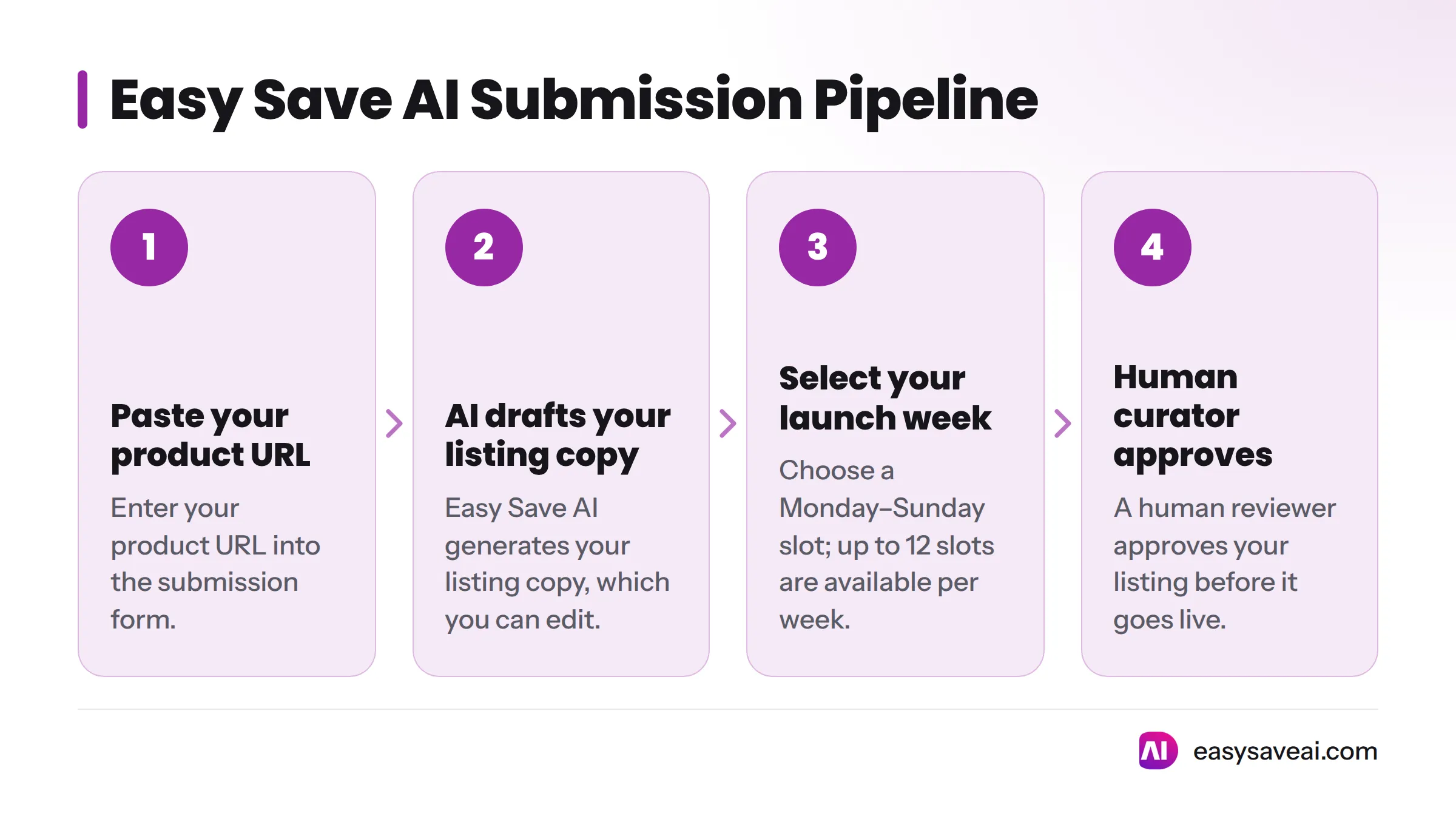
Submission pipeline (step by step):
- Paste your product URL into the submission form
- Easy Save AI's AI drafts your listing copy, which you can edit
- Select your preferred launch week - Monday through Sunday slots, with up to 12 available per week
- A human curator reviews and approves your listing before it goes live
That four-step pipeline means every listed product has passed human review, which keeps the directory quality high and gives listed products a curation signal that automated directories cannot match.
Listing permanence: Yes - your product page lives on Easy Save AI permanently. It stays indexed, earns ongoing organic traffic, and continues to pass link equity to your site on paid tiers.
Backlink: Do-follow on paid tiers. Free-tier listings receive a no-follow link.
Audience: Indie SaaS founders, AI tool creators, early adopters who specifically browse AI and SaaS directories. Tight fit for the exact audience most solo makers are trying to reach.
Free tier: Available from week 3 onward, includes a branded badge you can display on your site.
Pricing: See Easy Save AI pricing tiers for current rates on earlier scheduling and premium placement options.
Disclosure: Easy Save AI publishes this page. We believe it belongs on this list - you can decide.
Verdict: Easy Save AI is the strongest choice for founders who want their listing to keep earning traffic and backlinks long after launch week closes. If permanent indexation and SEO value matter to you, this is the platform to prioritise. Submit your tool to get started.
3. Uneed - Best for Weekly Curated Drops
Uneed is a weekly curated product directory that surfaces new tools to an audience of tech enthusiasts and early adopters. Products are accepted via a submission queue and featured in weekly batches rather than a continuous stream.
The main difference from Microlaunch is the weekly cadence. Uneed batches submissions into themed weekly drops, which creates a curation signal - being featured means a human editor selected your product over others submitted the same week.
Listing permanence: Uneed maintains an archive of past featured products. Your product page remains accessible after the launch week, though active promotion is limited to the week of your feature. For a deeper comparison of platforms similar to Uneed, see Uneed alternatives.
Backlink: Uneed links are no-follow, based on a site-level link attribute audit as of 2026.
Audience: A curated community of early adopters and tool enthusiasts. Smaller than Product Hunt but tighter in focus, which often translates to higher engagement rates per impression.
Submission: Human-curated. The editor selects products from the submission queue each week. Timing and quality both affect your chances of being featured.
Cost: Free to submit.
Verdict: Uneed is the right pick for makers who value editorial selection and a structured weekly slot. The audience is engaged and genuinely interested in new tools, but the SEO value is limited by no-follow links and modest domain rating relative to Product Hunt.
4. BetaList - Best for Early-Access Beta Signups
BetaList is a pre-launch focused directory that connects founders with early adopters who actively seek beta access to unreleased products. It's designed for products that have not yet launched publicly - founders use it to build waitlists and gather early feedback before a full launch.
The main difference from Microlaunch is timing. Microlaunch is for live products; BetaList is for products still in beta. If you submit a fully launched product, BetaList is a weaker fit.
Listing permanence: BetaList maintains permanent product pages in its directory. Past listings remain indexed and accessible.
Backlink: BetaList outbound links carry no-follow attributes, per BetaList's current listing structure. Free-tier listings are queued and can take several weeks to go live; paid options accelerate the process.
Pricing: BetaList operates on a freemium model. Free submissions enter a standard queue with a wait time that can stretch to several weeks. A paid fast-track option publishes your listing within a few days. See BetaList's current pricing for up-to-date rates.
Audience: Early adopters who specifically opt in to test unreleased products. High intent, high engagement, but a smaller total audience than Product Hunt.
Verdict: BetaList is the best Microlaunch alternative if you have not yet launched publicly and want to build a waitlist of motivated beta testers. Skip it if your product is already live - the audience expects beta access, not a finished product.
5. Hacker News (Show HN) - Best for Developer-Focused Launches
Hacker News, operated by Y Combinator, hosts a "Show HN" thread format where founders post their products directly to the Hacker News community for feedback and discussion. It is not a directory in the traditional sense - there is no dedicated product page, no submission pipeline, and no listing that persists after the thread drops off the front page.
The main difference from Microlaunch is structure. Microlaunch gives you a permanent product page; Hacker News gives you a comment thread that disappears from active view within 24 to 48 hours. What you gain is access to one of the most technically sophisticated and critically engaged communities on the internet.
Listing permanence: None. The thread remains in Hacker News archives, but it receives no ongoing traffic or promotion.
Backlink: The link in your Show HN post is no-follow and carries no link equity.
Audience: Software engineers, technical founders, open-source contributors, and investors. Extremely high signal for developer-facing tools. Poor fit for consumer apps or non-technical products.
Submission: No editorial review. Post directly with the "Show HN:" prefix in your title. Quality of feedback correlates strongly with the quality of your post.
Cost: Free.
Verdict: Use Show HN for developer tools, open-source projects, or any product where technical feedback is more valuable than directory SEO. Do not expect lasting visibility or backlink equity.
6. Launching Next - Best Low-Friction Submission for Early-Stage Tools
Launching Next is a lightweight startup directory with a low barrier to entry. It accepts submissions across a broad range of product categories with minimal curation, making it one of the fastest ways to get a product listed anywhere on the web.
The main difference from Microlaunch is curation. Microlaunch applies editorial standards; Launching Next prioritises speed and accessibility. For a launch platform for solo makers who want a quick first listing while still refining their product, that trade-off can be worth it.
Listing permanence: Launching Next maintains a permanent directory of submitted products. Your listing stays live after submission.
Backlink: Launching Next passes do-follow links to listed products as of 2026, which gives it an SEO advantage over several better-known platforms on this list despite its smaller audience.
Audience: General early-stage product browsers. Smaller and less targeted than Product Hunt or Uneed, but useful as a first listing when you need any initial web presence.
Submission: Lightweight review. Submissions are accepted quickly with minimal friction.
Cost: Free.
Verdict: Launching Next is the right starting point when you are not yet ready for curated platforms and want a quick, SEO-friendly first listing. The do-follow link at no cost makes it a worthwhile addition to any launch stack regardless of which other platforms you use.
7. Indie Hackers - Best for Founder Community Validation
Indie Hackers, founded by Courtland Allen and acquired by Stripe in 2017, is a community platform where bootstrapped and indie founders share revenue figures, growth stories, and product feedback. It includes a product directory where founders can create a product profile, but its primary value is the forum community rather than a traditional launch listing.
The main difference from Microlaunch is the nature of the audience. Indie Hackers is a founder-to-founder community. The people engaging with your product listing are other makers, not end users. That makes it strong for peer validation, honest critique, and building in public - but weak for acquiring paying customers directly.
Listing permanence: Product profiles are permanent, but they receive no algorithmic promotion after initial posting.
Backlink: Indie Hackers links are no-follow.
Audience: Bootstrapped and indie founders, solo makers, early-stage entrepreneurs. High engagement from people who understand the founder journey.
Submission: Self-service product profiles with no editorial curation.
Cost: Free.
Verdict: Indie Hackers is the best platform on this list for community validation and building in public. It is not the right choice if your primary goal is SEO-driven listing permanence or reaching paying customers. Use it alongside a directory-focused platform, not as a replacement.
Which Microlaunch Alternative Should You Choose in 2026?
Here's the goal-based decision table:
| Your Primary Goal | Best Platform |
|---|---|
| Permanent listing + SEO backlinks | Easy Save AI |
| Maximum launch-day reach | Product Hunt |
| Pre-launch beta signups | BetaList |
| Developer feedback | Hacker News Show HN |
| Weekly curated editorial slot | Uneed |
| Quickest first listing (do-follow, free) | Launching Next |
| Founder-community peer validation | Indie Hackers |
My honest recommendation: don't pick one. Launch on two or three platforms at the same time. A typical high-performing launch stack looks like this - submit to Easy Save AI for permanent indexation and SEO value, post on Hacker News if your product is developer-facing, and hit Product Hunt for maximum day-one exposure. Add Launching Next for a free do-follow link that costs you nothing. BetaList belongs before the others if you are still in beta.
The solo makers I see get the most out of their launches treat these platforms as complementary, not competing. Launch week is finite; the listings that survive it are the ones that keep working.
This video walks through the broader question of where and how to launch a SaaS in 2026, with a practical breakdown of platform options:
Ready to get a permanent listing with a do-follow backlink? Submit your tool to Easy Save AI - free from week 3 onward, or see Easy Save AI pricing tiers for earlier scheduling and premium placement.
Frequently Asked Questions
What is a good alternative to Microlaunch?
The best Microlaunch alternatives for indie SaaS and AI founders in 2026 are Easy Save AI, Product Hunt, Uneed, BetaList, Hacker News Show HN, Launching Next, and Indie Hackers. The right one depends on whether you value permanent listing, do-follow links, pre-launch beta signups, or maximum community reach.
Do Microlaunch alternatives offer permanent listing?
Some do and some rotate products out after a launch window. Easy Save AI offers a permanent listing - your product page stays indexed indefinitely after launch week. BetaList and Launching Next also maintain permanent directory pages. Product Hunt archives listings but stops promoting them after launch day. Hacker News has no dedicated listing at all. Always check a platform's current policy before you submit.
Are there cheap Microlaunch alternatives?
Yes - several have free tiers or low-cost paid options. Easy Save AI offers a free launch with a branded badge available from week 3 onward. Product Hunt, Hacker News, Uneed, Launching Next, and Indie Hackers are all free to submit. BetaList is freemium, with a paid fast-track option for faster publication. See Easy Save AI pricing tiers for current rates on earlier scheduling and premium placement.
Sources
- Uneed - Product discovery platform
- Launching Next - Startup directory
- Indie Hackers - Founder community and product profiles
- Hacker News - Show HN guidelines
- Y Combinator - About
- Easy Save AI - Submit your AI tool
- Easy Save AI - Pricing tiers
- Easy Save AI - Product launch platforms comparison
- Easy Save AI - Free domain rating checker