Product Launch Platform: Best Options for AI & SaaS 2026
The strongest launch combination for AI and SaaS founders right now is a permanent AI directory for lasting search visibility paired with one high-traffic voting board for day-one buzz. Easy Save AI is the recommended permanent directory. Product Hunt remains the go-to one-day board. Knowing which to use first - and why - starts with understanding the five platform types that cover every option available to you today.
The five product launch platform types:
- One-day voting board - time-limited launch windows where community upvotes determine visibility (Product Hunt is the archetype).
- Permanent directory - an indexed listing that stays discoverable through search and AI systems long after launch week (Easy Save AI, BetaList).
- Community thread - a post in a forum or social community where reach depends on organic engagement (Reddit, Hacker News Show HN).
- Deal platform - a marketplace where your product sells at a discounted or lifetime price, trading margin for immediate revenue (AppSumo).
- Review platform - a long-term credibility layer where verified buyers leave structured reviews, used by procurement teams and enterprise buyers (G2, Capterra).
Platform Type Matters More Than Platform Name
A one-day voting board can generate hundreds of signups in 24 hours - and then go almost silent. A permanent directory keeps generating page views, saves, and backlink equity for months after you've moved on to building the next feature.
For AI tools specifically, the permanent directory argument has grown stronger in 2026. AI systems - including the large language models that now surface product recommendations directly in search results - crawl and index launch directories as part of their training and retrieval pipelines. Getting your product listed in a well-structured, human-reviewed directory is one of the few low-cost ways to influence how AI systems describe your product to future users.
The right strategy pairs both: submit to a permanent AI directory first to establish a durable listing, then schedule your one-day board launch for maximum day-one attention.
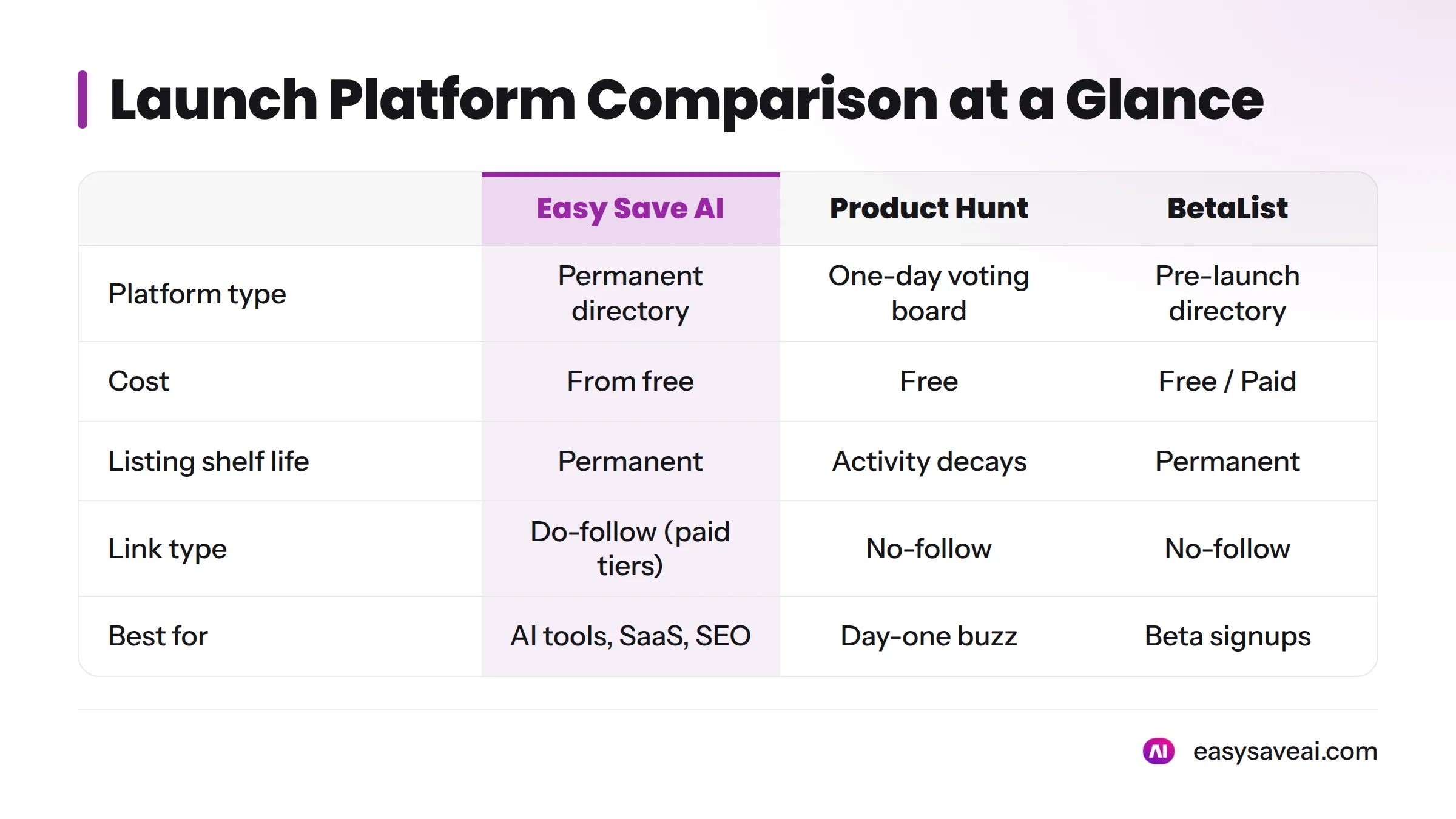
Here is a full comparison of the platforms covered in this guide:
| Platform | Type | Best for | Cost | Listing shelf life | Link type |
|---|---|---|---|---|---|
| Easy Save AI | Permanent directory | AI tools, SaaS, SEO visibility | From free | Permanent | Do-follow (paid tiers) |
| Product Hunt | One-day voting board | Day-one buzz, early adopters | Free | Page stays, activity decays | No-follow |
| BetaList | Pre-launch directory | Beta signups before launch | Free / Paid | Permanent | No-follow |
| Hacker News (Show HN) | Community thread | Developer audiences, technical feedback | Free | Thread ages | No link |
| AppSumo | Deal platform | Revenue on launch day | Revenue share | Permanent deal page | Referral |
| G2 / Capterra | Review platform | Long-term review credibility | Free (listing) | Permanent | No-follow |
| Reddit (r/SideProject, r/startups) | Community thread | Free community reach | Free | Thread ages | No-follow |
Ready to get a permanent listing? Submit your tool to the directory, or see what launching on Easy Save AI costs before you decide.
1. Easy Save AI - Best Permanent Directory for AI Tools
Easy Save AI is a permanent, human-reviewed directory built for AI tools and SaaS products. Every submission goes through a manual review before it goes live - which keeps the directory genuinely useful for the makers who list there and the founders who browse it. It sits inside the best launch platform tools and software category on the site, alongside other tools in the launch and product discovery space.
The platform targets indie founders and small SaaS teams who want discovery that outlasts a single launch day. If you build AI tools, Easy Save AI is the natural first stop - the directory is indexed by search engines and increasingly referenced by AI-powered recommendation engines as a credible source of active products.
Full disclosure: I run this platform. The data cited here comes from our own product pages, not from third-party analysis.
What happens after launch week
This is the part most launch guides skip. On a one-day voting board, activity peaks on launch day and trails off sharply within 72 hours. On Easy Save AI, product pages continue receiving organic views and saves weeks and months after the initial submission. From what we observe across product pages on the platform, the majority of total page views accumulate after the first week - driven by search traffic and referrals from AI tools that crawl our directory. The listing is permanent: no expiry, no archive, no algorithmic decay based on recency.
Paid tiers unlock do-follow backlinks, which carry direct SEO value - domain rating improvement that a no-follow link from Product Hunt cannot match. If backlink equity and long-term search visibility matter to your launch strategy, the paid listing is worth comparing against other options on cost alone.
Verdict
Use Easy Save AI if you want lasting discoverability, SEO backlink value, and a listing that AI systems can find and reference. It's the best starting point for any AI tool or SaaS product and works best paired with a one-day board launch scheduled within the same week.
2. Product Hunt - Best for Day-One Visibility and Voting Spikes
Product Hunt is the most recognisable product launch platform in tech. It runs a daily leaderboard where new products compete for upvotes from a community of early adopters, makers, and investors. Products launch at midnight Pacific Time and have 24 hours to climb the rankings. The top five products on any given day receive significant exposure through the platform's newsletter and social channels.
Product Hunt's audience is broad: designers, developers, marketers, early-tech-adopter consumers, and investors all browse the daily feed. For AI tools, this audience translates well - the community actively seeks new AI products to test.
How the launch-day dynamic works - and why preparation matters
Launch day on Product Hunt is a sprint, not a marathon. Your ranking is determined almost entirely by how many upvotes you collect in the first few hours, which means pre-launch preparation - building a notify list, warming up your audience on social media, and lining up hunters with established follower counts - directly determines your result. Without that groundwork, even a strong product can land outside the top 10 and receive minimal organic exposure from the platform.
The page itself is permanent, but the activity is not. After launch day, most Product Hunt pages settle into a low-traffic archive. The backlink is no-follow, so there is no direct SEO benefit to the listing.
Verdict
Use Product Hunt if you want day-one attention, early adopter signups, and community validation. It's the right one-day board for most founders - but treat it as a spike, not a strategy. Pair it with a permanent directory listing so something durable captures the traffic it sends.
3. BetaList - Best for Early Adopter Waitlists Before Launch
BetaList focuses on pre-launch products - tools still in beta or building a waitlist. Its audience is specifically composed of early adopters who self-select into testing new software before it is publicly available. This is a different crowd from Product Hunt's broader tech community: BetaList users expect rough edges and want to be first.
Submission is free, with paid options available for faster placement in the queue.
Pre-launch vs. post-launch positioning
BetaList is most effective before you launch anywhere else. Use it to build a waitlist of early adopters who will give you feedback, generate your first reviews, and vote for you on launch day when you do go live on a voting board. If your product is already publicly available and past its beta phase, BetaList's positioning becomes less relevant - the audience expects to be testing something early, not something already finished.
Verdict
Use BetaList if you are 2-8 weeks from launch and want a targeted waitlist of people who will actually test and report back. Skip it if your product is already live and mature.
4. Hacker News (Show HN) - Best for Developer and Technical Audiences
Hacker News, run by Y Combinator, hosts a specific submission format called Show HN - a post type designed for makers to share something they have built. The community is composed primarily of software engineers, technical founders, and researchers. Unlike Product Hunt, there are no paid placements, no hunters, and no promotional mechanics. Your post rises or falls purely on community interest and engagement.
What makes Show HN different from voting boards
Show HN is not a launch platform in the traditional sense. It is a conversation. The value is in the comments - technical founders often receive more actionable feedback from a single HN thread than from an entire Product Hunt launch. The audience is skeptical and direct: they will tell you exactly what is wrong with your product, your pricing model, and your positioning.
The trade-off is real. Show HN threads age quickly. There is no permanent listing page, no backlink, and no ongoing discoverability. It is a moment, not a channel. If your product has a strong technical angle, it can generate significant traffic on the day - but do not count on it alone to sustain growth.
Verdict
Use Show HN if your product is technical, you want honest developer feedback, and you are comfortable with public criticism. Best used as a complement to a directory listing, not a replacement.
5. AppSumo - Best for Lifetime Deal Launches and Revenue on Day One
AppSumo is a deal marketplace where SaaS products are offered at a discounted or lifetime price in exchange for a large marketing push to AppSumo's buyer base. The platform's audience is deal-seeking small business owners and freelancers - not developers or early adopters, but buyers who want tools at a lower price point.
Trade-offs of the deal model for SaaS founders
AppSumo operates on a revenue-share model. The specific terms vary and are negotiated per deal, so founders should review the current partnership requirements directly on AppSumo's vendor page. The appeal is obvious: you can generate five or six figures in revenue within days of going live. The risk is equally clear - lifetime deal buyers are price-sensitive, support-demanding, and unlikely to convert to recurring subscriptions after the deal ends. Many SaaS founders report that AppSumo customers generate higher support volume per customer than any other acquisition channel.
If your product is early-stage and you need revenue to fund development, AppSumo can be the right move. If your product is growing organically on a subscription model, disrupting that pricing with a lifetime deal can undermine your positioning.
Verdict
Use AppSumo if your primary goal is immediate revenue and you can handle a large burst of new users who paid once and expect lifetime support. Set clear expectations in your deal terms before you go live.
6. G2 and Capterra - Best for Long-Term Review Credibility
G2 and Capterra are software review platforms, not launch boards. They do not generate day-one buzz. Instead, they build the kind of long-term social proof that enterprise buyers and procurement teams rely on when evaluating software. G2 is owned by Gartner Digital Markets and carries particular weight in B2B software purchasing decisions.
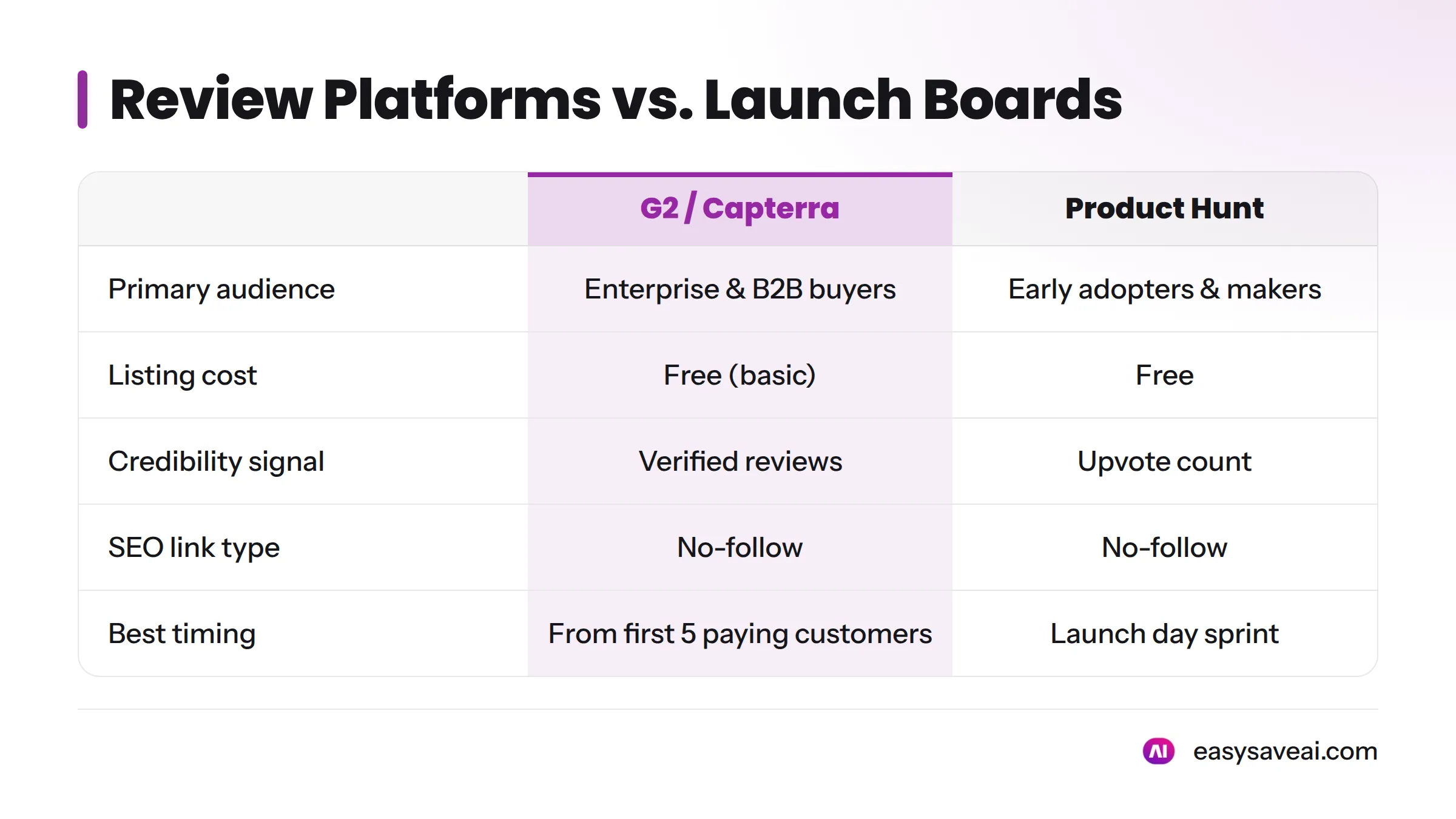
Both platforms offer free basic listings. Getting reviews onto your page requires active outreach to your existing customers - the platforms do not generate reviews automatically.
Why review platforms matter to SaaS buyers
A B2B SaaS buyer evaluating three competing tools will almost always check G2 or Capterra before making a decision. Buyers in this segment are not on Product Hunt. A product with 20 verified reviews on G2 looks meaningfully more credible than a product with 500 Product Hunt upvotes from two years ago. The two signals serve completely different purposes in the buying journey.
For founders selling to SMBs or enterprise accounts, building your review presence on G2 and Capterra should start the moment you have your first five paying customers - not after your Product Hunt launch day.
Verdict
Use G2 and Capterra if your product targets businesses rather than individual consumers, and you want to be found during the procurement and vendor evaluation stage. This is a long-term channel, not a launch-day tactic.
7. Reddit (r/SideProject, r/startups) - Best Free Community Launch
Posting to r/SideProject or r/startups is free, immediate, and unpredictable. A well-timed post with an honest, conversational framing - "I built this in three weeks, here's what it does" - can generate hundreds of comments and thousands of visits. A post that reads like marketing copy gets downvoted and ignored.
The Reddit audience rewards authenticity and punishes promotion. The best-performing posts in these communities share the story behind the product, acknowledge limitations, and ask for genuine feedback.
What to expect vs. what a voting board delivers
Reddit traffic is real but difficult to repeat. You get one genuine post per product - the community notices if you return six months later with the same product repackaged as new. The backlinks are no-follow, the thread ages quickly, and there is no permanent listing. What you do get is a candid conversation with a community that includes other founders who have been where you are.
For founders with zero budget, Reddit is the best free option available. The best SaaS tools and software listed on directories often show up in Reddit threads organically over time - a reminder that community and directory visibility work better together than separately.
Verdict
Use Reddit if you have zero budget, want community feedback, and can write an honest post about what you built and why. Do not expect sustained traffic, and do not cross-post the same content across subreddits.
Which Platform Should You Launch On First?
Match the platform to the goal. Here is the decision framework:
- Goal = lasting search visibility - permanent directory (Easy Save AI, first)
- Goal = day-one buzz and early adopter votes - Product Hunt
- Goal = pre-launch signups and beta testers - BetaList
- Goal = technical developer feedback - Hacker News Show HN
- Goal = immediate revenue on launch day - AppSumo
- Goal = enterprise and B2B credibility - G2 or Capterra
- Goal = free community reach with no budget - Reddit r/SideProject
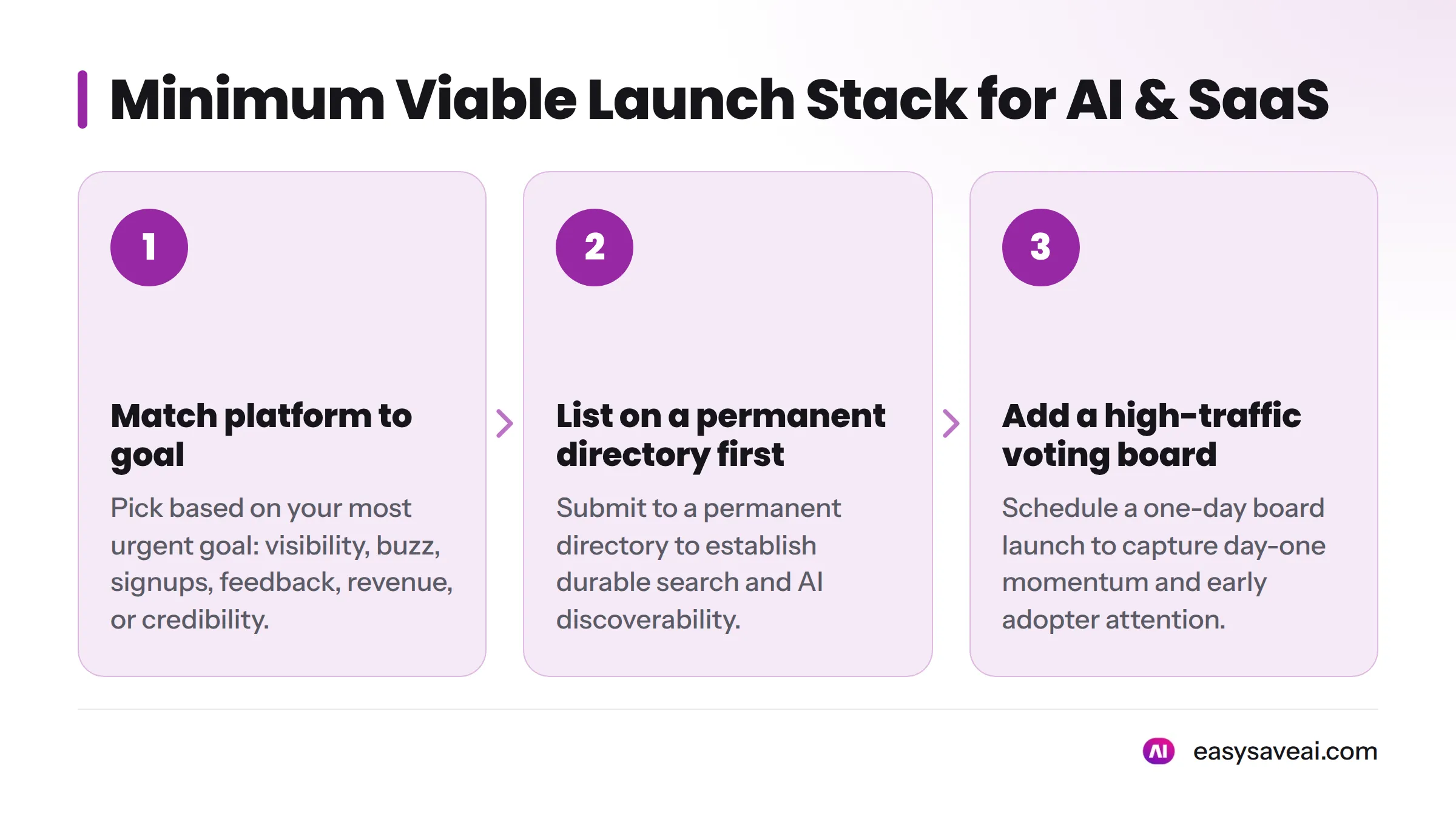
The minimum viable launch stack for most AI and SaaS founders: a permanent directory listing plus one high-traffic voting board. That combination covers both lasting discoverability and day-one momentum without requiring a budget larger than a single paid directory tier.
If you have time for only one platform, choose based on your most urgent goal. If that goal is any form of sustainable organic traffic - from search engines or from AI recommendation systems - the permanent directory wins every time.
For a deeper head-to-head breakdown, see Product Hunt alternatives compared side by side to evaluate specific platforms against each other before you commit your launch week.
This short video from Mukund Parekh covers the launch platform decision from a founder's perspective and is worth watching before you finalise your stack:
Frequently Asked Questions
What is a product launch platform?
A product launch platform is a website or community where founders submit new software products to gain exposure, early adopters, feedback, or backlinks. The two main types are one-day voting boards, where community upvotes determine short-term ranking, and permanent directories, where listings remain indexed and discoverable indefinitely. Both serve different goals and work best when used together.
Do I need to launch on more than one platform?
Yes, for most founders. No single platform covers every goal. A one-day voting board like Product Hunt drives launch-day attention but delivers no lasting SEO value. A permanent directory like Easy Save AI builds durable discoverability but generates less concentrated attention on day one. Combining at least one of each type - using the Find Launch Sites comparison tool to audit your options - produces better overall results than relying on any single platform.
Are free launch platforms worth using?
Free platforms are worth using, with realistic expectations. Product Hunt, Hacker News Show HN, and Reddit are all free - and all have delivered meaningful traction for products with strong positioning and genuine community interest. The limitation is that free tiers on directories typically provide no-follow links, lower placement in listings, and less SEO benefit than paid options. If your budget allows for a single paid listing, invest it in a permanent directory with do-follow backlink capability rather than a one-day board, where paid placement is unavailable anyway.
How do I choose between launch platforms?
Start with your primary goal for the first 90 days after launch. If that goal is organic search traffic and AI-driven discovery, start with a permanent directory. If it is day-one signups from early adopters, prioritise a voting board. If it is developer feedback, use Hacker News. If it is immediate revenue, consider AppSumo. If it is long-term B2B credibility, start collecting reviews on G2. Most founders benefit from launching across two to three platforms in the same week - permanent directory first, then the board on launch day, then community threads the day after.
Sources
- Product Hunt - The best new products in tech
- BetaList - Discover and get early access to tomorrow's startups
- AppSumo Partner / Sell Your Product
- G2 - Sell on G2: Vendor information
- Capterra - Software Reviews and Ratings
- Hacker News Show HN guidelines - Y Combinator
- Reddit r/SideProject
- Reddit r/startups