SEO Backlinks for Startups: 7 Sources That Work in 2026
The best SEO backlinks for a new startup in 2026 come from seven proven sources: curated AI and SaaS directories, product launch platforms, niche blog roundups, guest posts on startup publications, founder community profiles and resource pages, podcast show notes, and original data or public tools. If your domain rating (DR) sits at zero, start with the first two - they require no existing authority and pass real link equity from day one.
Two Concepts That Drive Every Backlink Decision
Before ranking the seven sources, two concepts determine every call a founder makes about startup link building.
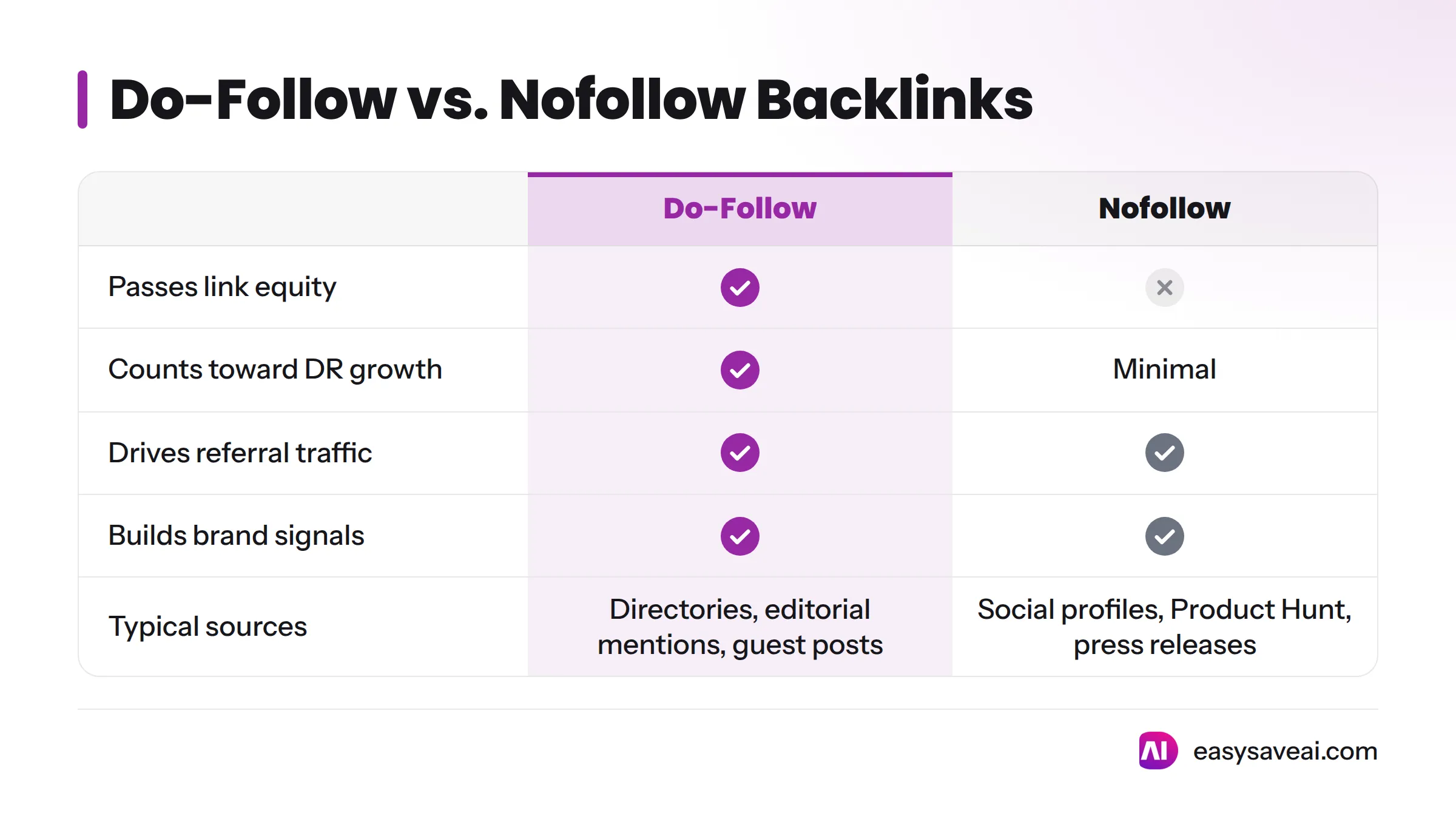
Do-follow vs. nofollow: A do-follow link carries no restrictive attribute, so search engines like Google follow it and pass link equity - the ranking signal - from the linking domain to yours. A nofollow link carries the rel="nofollow" attribute, which tells search engines not to pass that equity. Nofollow links still drive referral traffic and build brand signals, but they do not move your DR or ranking power on their own. A healthy backlink profile mixes both, but do-follow links do the heavy lifting.
Domain rating (DR): DR is a 0-100 scale, developed by Ahrefs, that measures the strength of a website's backlink profile relative to all other sites in their index. A new SaaS launching today typically starts at DR 0-2. Based on outcomes observed across listings in the Easy Save AI directory, most early-stage products reach DR 5-15 within their first three to six months of active link building - primarily through directory and roundup placements. DR matters because higher-DR linking domains pass stronger equity, and your own DR influences which publications and podcasts will accept you as a contributor or guest.
| Feature | Do-Follow | Nofollow |
|---|---|---|
| Passes link equity | Yes | No |
| Counts toward DR growth | Yes | Minimal |
| Drives referral traffic | Yes | Yes |
| Builds brand signals | Yes | Yes |
| Typical sources | Curated directories, editorial mentions, guest posts, podcast show notes | Social profiles, most Product Hunt pages, press release syndication |
The seven sources below are ranked by three factors: link type (do-follow or nofollow), effort required (low, medium, or high), and fit for a brand-new SaaS or AI product with a DR under 10. This ranking reflects my own observed outcomes from running Easy Save AI as a curated directory, checking domain data through the site's DR tool, and testing each category with real startup listings.
1. AI and SaaS Directories - Best First Move for Do-Follow Equity
| Link type | Do-follow |
| Effort | Low |
| Fit for new SaaS | ★★★★★ |
Curated AI and SaaS directories are the strongest first move for a startup with no existing authority. The reason is structural: a directory listing is a permanent, indexed page that links back to your product page, and curated directories - ones where a human or editorial process filters submissions - carry topical relevance that generic link farms never will. Relevance is a core signal in how link equity is judged by search engines.
From our own first-party data at Easy Save AI, do-follow status is confirmed for paid listings, meaning the outbound link to your product page carries no nofollow attribute and passes equity directly. New products that go from DR 0 to DR 5-8 in their first 60 days almost always have at least two or three curated directory listings anchoring their early backlink profile.
One important distinction: curated directories screen submissions for quality and fit. Open, uncurated directories accept anything and have historically attracted Google penalties for link manipulation. Stick to directories where editorial judgment is part of the process - the link value is meaningfully higher, and there is no downside risk.
You can check your domain rating with the DR checker before and after a directory submission to see the equity movement firsthand. When you are ready to list your product, submit your tool for a do-follow listing - it takes under five minutes and the link goes live once approved.
2. Product Launch Platforms - High-Traffic, Brand-Building Links
| Link type | Nofollow (most platforms) / Do-follow (select platforms) |
| Effort | Low-Medium |
| Fit for new SaaS | ★★★★☆ |
Product Hunt is the most visible launch platform for SaaS and AI products. It drives genuine referral traffic during launch week - sometimes thousands of visits in 24 hours - and places your product in front of early adopters, investors, and journalists who actively look for new tools. The backlink from Product Hunt itself is nofollow, meaning it does not pass direct link equity, but the brand signal it creates is real: press mentions, social shares, and downstream editorial links often follow a successful launch, and those secondary links frequently are do-follow.
Some smaller launch platforms do pass do-follow links, so it is worth checking each platform via a DR checker before submitting. For a comprehensive look at which platforms offer the best combination of traffic and link type, the Best Product Launch Platforms for AI & SaaS page ranks them in detail. If Product Hunt feels like a crowded playing field, the Best Product Hunt Alternatives for AI & SaaS Founders guide covers platforms where a new product can stand out more easily.
The strategic play is to combine a directory listing with a launch platform submission during the same week. The directory provides the do-follow equity; the launch platform provides the traffic surge and brand signal. Together, they create a compound effect that neither achieves alone.
3. Niche Blog Roundups and 'Best Of' Lists - High DR, Contextual Links
| Link type | Do-follow (typically) |
| Effort | Medium |
| Fit for new SaaS | ★★★★☆ |
A blog roundup is an editorial article - "Best AI writing tools in 2026," "Top productivity apps for remote teams," "10 SaaS tools worth your subscription" - that links out to the products it recommends. These are contextual backlinks: the link sits inside relevant editorial prose, surrounded by content that signals to search engines exactly what your product does. That context strengthens the equity the link passes.
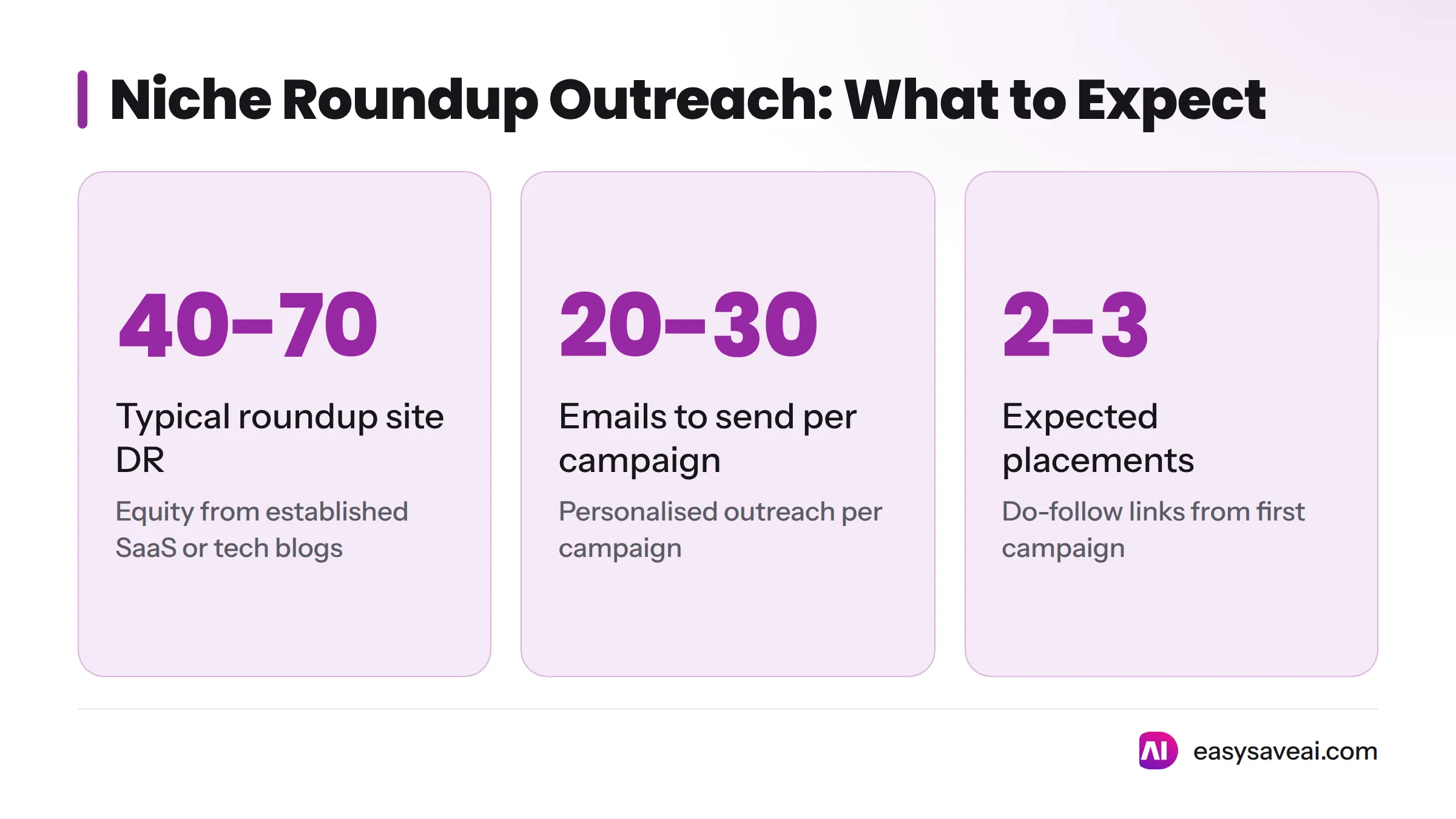
Roundup links from established SaaS or tech blogs often come from domains with DR 40-70, which means the equity transfer to your new domain is meaningful. Finding them is straightforward: search for "[your category] best tools [year]" or "[your category] alternatives" and look for articles that rank on page one but do not yet include your product. Then reach out to the author with a short, specific pitch explaining what your tool does differently from what they already list.
The effort here is medium because outreach takes time and response rates vary. Expect to send 20-30 personalised emails to land two or three placements in your first campaign. The payoff is a do-follow link from a domain that is actively read by your target audience - a contextual backlink that both passes equity and sends qualified readers to your product. For tools that help you identify and prioritise roundup targets, the Best SEO Tools & Software collection is a practical starting point.
4. Guest Posting on Startup and SaaS Publications - Effort-Heavy but Authoritative
| Link type | Do-follow (most SaaS publications) |
| Effort | High |
| Fit for new SaaS | ★★★☆☆ (better after initial DR is established) |
Guest posting places a bylined article - written by you, the founder - on a third-party publication in your niche. The article typically includes one or two do-follow links back to your site, anchored with either your brand name or a relevant phrase. When the host publication has a DR of 50 or higher, a single guest post can noticeably shift your backlink profile.
The honest catch: most publications worth targeting will look up your domain before accepting a pitch. If your DR is 0, you will get ignored far more often than not. Guest posting is not a first move - it is a second-phase strategy after you have established a small base of directory and roundup links that push your DR above 10.
Anchor text matters more here than in directories. For a new SaaS, lean toward branded anchors ("Easy Save AI" rather than "best AI tool directory") in your early guest posts. Over-optimised, keyword-rich anchors on a fresh domain can attract scrutiny under Google's link scheme guidelines. Branded anchors are safe, natural-looking, and still pass full equity.
Note: Guest posting gets harder without a DR baseline - build a small profile first with directories and roundups, then come back to this channel once you have something for editors to verify.
5. Founder Community Profiles and Resource Pages - Low Effort, Steady Gains
| Link type | Mixed (nofollow on most social profiles; do-follow on some community and resource pages) |
| Effort | Low |
| Fit for new SaaS | ★★★★☆ |
Founder communities - Indie Hackers, Hacker News, niche Slack groups, founder forums - let you create profiles and post about your product. The profile links are almost always nofollow. They pass minimal direct equity, but they build something equally important early on: brand signals. When Google sees your product mentioned consistently across multiple platforms, it starts to associate your brand name with your category.
The higher-value variant is resource page outreach. Many blogs and community sites maintain a "tools we recommend" or "resources for founders" page. These pages often link out with do-follow links and rarely get updated, meaning a placement can stay live and pass equity for years. Finding them takes a targeted search - "[your category] + resources," "[your niche] + tools we use" - and a brief, genuine outreach email.
Resource page placements require more research than a directory submission but less ongoing effort than guest posting. For founders watching their budget, free backlink options from community platforms and resource pages can supplement paid directory listings effectively.
Treat community profiles as brand-building, not equity-building. Treat resource pages as a do-follow opportunity worth dedicating real time to.
6. Podcast Show Notes and Interview Mentions - Relationship-Driven Links
| Link type | Do-follow (most podcast show notes) |
| Effort | Medium |
| Fit for new SaaS | ★★★☆☆ |
Podcast show note links are one of the most underrated sources of high quality backlinks for SaaS founders. When a podcast publishes an episode, its show notes page - hosted on the podcast's website - typically includes a do-follow link to every guest's product or website. These links are permanent, indexed by search engines, and placed in content that is topically relevant to your space.
The effort is medium because you need to identify podcasts that fit your niche, craft a pitch that positions you as a useful guest rather than just a product promoter, and then record the episode. Startup and SaaS-focused podcasts that accept founder guests include shows covering indie product building, bootstrapping, and AI tools - a category that has expanded significantly in 2026.
Volume is lower than directories or roundups: a good podcast campaign might produce three to eight links in a quarter. Those links tend to be high-relevance and long-lived, and the audience trust that comes with a podcast appearance compounds beyond the link itself. Listeners who hear you on a show they already trust are warmer prospects than anyone who finds you through a cold search result.
Compared to a blog post link, a podcast show note link is similar in equity value - both are typically do-follow, both are contextual, and both sit on third-party domains. The difference is the relationship behind the podcast link, which often leads to additional mentions, referrals, and co-promotions that blog outreach rarely produces.
Here is a useful video covering startup-specific link building tactics, including community and outreach-based approaches:
7. Original Data and Public Tools - Passive Link Magnets
| Link type | Do-follow (editorial citations) |
| Effort | High (upfront) / Low (ongoing) |
| Fit for new SaaS | ★★★☆☆ (longer payoff) |
Original data - a survey, benchmark report, proprietary dataset, or free calculator - attracts backlinks passively once it is published and indexed. Writers and bloggers who cover your niche need statistics and tools to reference. If you are the source of a stat they cannot find elsewhere, they cite you, and most editorial citations carry a do-follow link.
The Easy Save AI DR checker is a practical example of this model: a free public tool that answers a specific question founders ask constantly ("what is my domain rating?"), requires no account to use, and generates both referral traffic and inbound links from SEO content that references it. You can check your domain rating with the DR checker to see the kind of tool I mean - the design is simple, the utility is immediate, and that combination is what makes tools linkable.
This is a long-game strategy. Building the data asset or tool takes real upfront investment. Unlike outreach-dependent sources, the links compound without ongoing effort. A benchmark report published in Q1 can still be generating new editorial citations in Q4. For a startup that can invest the time, it is the highest-leverage link building channel available - just not the right starting point when your DR is 0.
Where Should a New SaaS Start Building Backlinks?
The answer depends on where your domain stands right now.
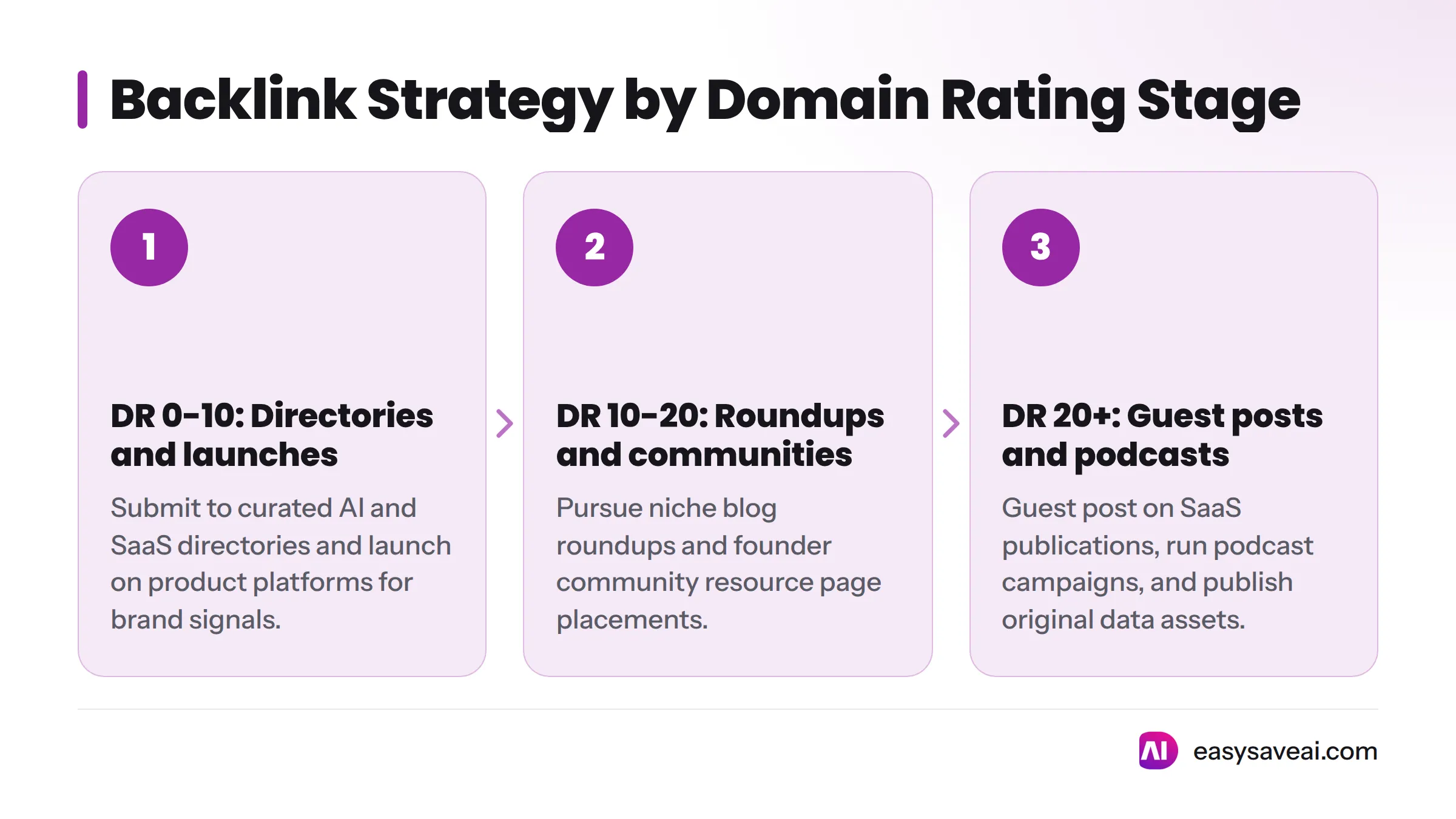
DR 0-10 - Start here:
- Submit to curated AI and SaaS directories (do-follow, low effort, no authority required)
- Launch on product launch platforms for brand signals and referral traffic
- These two channels alone can move a new SaaS from DR 0 to DR 8-12 within 60-90 days, based on outcomes observed across Easy Save AI directory listings
DR 10-20 - Add these:
- Pursue niche blog roundups and 'best of' lists (contextual do-follow links from higher-DR domains)
- Build out founder community resource page placements (mixed link types, worth the outreach effort)
DR 20+ - Expand to:
- Guest posting on startup and SaaS publications (do-follow, authoritative, now accessible given your DR baseline)
- Podcast show note campaigns (do-follow, relationship-driven, compounds over time)
- Original data or public tool assets (highest long-term return, requires upfront investment)
Do-follow links are the priority at every stage. Nofollow links from launches, social profiles, and community platforms support your brand signals and referral traffic, but they will not drive ranking gains on their own. A healthy backlink profile eventually contains both - the do-follow links do the ranking work, the nofollow links make the profile look natural.
Quality of referring domains beats quantity, every time. A new SaaS with 15 do-follow links from curated, topically relevant directories and roundups will outrank a competitor with 200 nofollow links from generic profiles. Focus on relevance and do-follow status first; volume follows naturally as your DR grows.
Your next two steps:
Check your domain rating with the DR checker to see where you stand today - it is free and takes ten seconds. Then submit your tool for a do-follow listing on Easy Save AI to put your first (or next) equity-passing link in place.
Frequently Asked Questions
What are the best backlinks for a new startup?
The best backlinks for a new startup are do-follow links from curated AI and SaaS directories, niche blog roundups, and editorial mentions from relevant publications. Start with sources that require no existing authority - curated directories and product launch platforms - then build toward guest posts and podcast appearances as your DR grows past 10.
Do startups need do-follow backlinks?
Yes. Do-follow links pass link equity and drive domain rating growth; nofollow links mostly do not. A healthy backlink profile contains both, but do-follow links from topically relevant sites are what move your rankings. For a zero-DR domain, do-follow sources should be the exclusive focus in the first 60-90 days.
How many backlinks does a new SaaS need?
There is no fixed number. Relevance and the quality of referring domains matter far more than raw count. A practical benchmark: check the backlink profiles of the two or three sites already ranking for your target queries and aim to match their referring domain count with comparable or higher-quality sources. For most early-stage SaaS products, 10-20 do-follow links from curated, relevant domains are enough to establish a competitive baseline in a low-competition niche.
What is a contextual backlink and why is it better than a generic directory link?
A contextual backlink sits inside editorial prose - a paragraph in a blog post or roundup - surrounded by content that signals what your product does. That context tells search engines the link is relevant and editorially placed, not just listed alongside thousands of unrelated sites. Contextual links typically carry stronger equity than a plain directory listing, which is why roundup and guest post placements are worth the extra effort as your DR grows.
How do I check whether a site is giving me a do-follow or nofollow link?
Right-click the link on the referring page, inspect the HTML, and look for rel="nofollow" in the anchor tag. If the attribute is absent, the link is do-follow. You can also use a backlink checker - including the Easy Save AI DR checker - to audit your profile and see which links carry the nofollow attribute and which do not.